
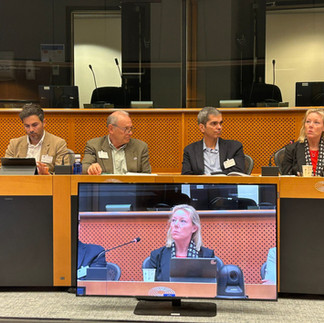
On June 4, policymakers, healthcare leaders, patient representatives, researchers and industry experts from across Europe gathered at the European Parliament in Brussels to discuss one of the most pressing questions facing European healthcare and innovation policy: how can Europe accelerate patient access to innovation while strengthening its global competitiveness in life sciences?
The high-level policy dialogue, organised by the PRECISEU consortium in collaboration with Members of the European Parliament and regional partners, focused on translating the European Commission's ambitions in the Choose Europe for Life Sciences 2030 strategy into concrete actions.
As a partner in PRECISEU, Sahlgrenska Science Park contributed evidence and recommendations based on extensive work across ten European regions to identify barriers and opportunities for personalised medicine and advanced therapies.
Moving from strategy to implementation
Europe remains a global leader in scientific excellence, research and medical innovation. Yet many promising innovations still struggle to reach patients due to fragmented regulatory systems, complex market access pathways and uneven implementation across regions and member states. A central theme throughout the dialogue was the need for stronger collaboration across Europe.
"We should not operate as separate islands but act together. This is where initiatives like PRECISEU make a real difference," said Nikos Papandreou, Member of the European Parliament.
Participants agreed that Europe now faces a critical implementation challenge: transforming scientific breakthroughs into accessible healthcare solutions while strengthening the continent's technological leadership and economic resilience.
Evidence from across Europe
As part of the programme, Gwen Gilderson from Sahlgrenska Science Park presented findings from PRECISEU's cross-regional analysis of personalised medicine ecosystems.
The work, which has involved more than 150 stakeholders across ten European regions, has identified common barriers related to regulation, clinical validation, reimbursement, market access and healthcare adoption. At the same time, it highlights successful regional approaches that can be scaled and replicated across Europe. The findings provide a practical foundation for policymakers seeking to strengthen Europe's innovation ecosystem and improve patient access to precision medicine.
"Europe does not lack excellence. What we need is stronger collaboration across regions, countries and innovation initiatives. If we want to accelerate patient access and remain globally competitive, we must connect excellence and turn fragmented efforts into coordinated action."
– Gwen Gilderson, Senior Project Manager at Sahlgrenska Science Park and lead of PRECISEU's market & patient access work package




Scaling advanced therapies
One of the policy panels focused on Advanced Therapy Medicinal Products (ATMPs), including cell and gene therapies, and explored how Europe can move from scientific leadership to scalable implementation. While Europe continues to produce world-class research, participants highlighted significant challenges in bringing innovations to patients at scale.
"Science is not the problem - scale is. We need to truly collaborate across Europe. Today's fragmentation is creating a valley of death for precision therapies," said David Morrow, Scientific Lead for Advanced Therapies at EATRIS-ERIC.
The discussion highlighted the need for coordinated regulatory frameworks, stronger healthcare infrastructure and increased investment to support the adoption of advanced therapies across Europe.
Clinical trials as a driver of competitiveness
The second policy panel examined how Europe can strengthen its clinical research ecosystem and remain an attractive location for clinical trials. Beyond their importance for healthcare, participants emphasised the strategic role that clinical trials play in driving innovation, investment and economic growth.
"Regions that lead innovation and successfully scale innovation will be the ones driving future economic growth. Clinical trials are essential, as they drive sustainable growth as well as resilience," said Ebba Hallersjö Hult, Co-founder of Vision Zero Cancer and member of the PRECISEU Advisory Board.
The panel called for greater efficiency, improved patient involvement and stronger collaboration between healthcare systems, researchers and industry to enhance Europe's competitiveness in clinical research.
Shared priorities for Europe's future
The dialogue concluded with a synthesis of key policy recommendations for European institutions, member states, regions and ecosystem stakeholders. Among the priorities highlighted were reducing regulatory barriers, strengthening clinical trial infrastructures and improving coherence across Europe.
"There are three priorities: addressing regulatory barriers, strengthening clinical trials and ensuring coherence across Europe," said Ester Borràs, Government Delegate to the European Union.
While participants represented different sectors and regions, there was broad agreement on one point: Europe has the scientific capabilities, talent and innovation capacity needed to lead the next generation of healthcare innovation. The challenge now is creating the conditions that allow these innovations to reach patients faster and at greater scale.
Through PRECISEU, Sahlgrenska Science Park continues to work with partners across Europe to strengthen regional innovation ecosystems, accelerate the adoption of personalised medicine and contribute to a more competitive, resilient and patient-centred European life sciences sector.